

What Personal Training Actually Costs in Seattle.
What Personal Training
Actually Costs in Seattle.
If you've tried to find out what personal training costs in Seattle, you've discovered the industry's open secret: almost nobody says. Websites ask for your email. Front desks say "it depends." And it genuinely does depend — but "it depends" without numbers is just a stall.
So here are the numbers, what actually moves them, and — the part most pricing pages skip — why the cost per session matters far less than the cost per result.
Nationally, in-person one-on-one training averages roughly $40–$100 per session. Seattle runs higher than the national middle, as you'd expect: training at commercial gyms commonly lands at $50–$110 per session, independent and specialist coaches mostly sit in the $75–$140 band, and premium or highly credentialed coaching goes above that. Committing to the standard cadence — two sessions a week — typically means $250–$400+ per month at the value end of the market, and more with experienced coaches.
The spread from $40 to $140+ isn't random. Four variables account for nearly all of it:
You're not buying hours. You're buying what the hours produce.
Here's the arithmetic that pricing pages never show. An $80-per-session trainer who runs you through a generic template for a year — because generic templates don't build independence — costs $8,320 at 2×/week. A $130 coach who assesses properly, programs for your body, teaches you to train, and deliberately tapers you toward independence over six months costs about $6,760 — and leaves you with a skill instead of a dependency. The "cheaper" option cost more and delivered less.
This is the same logic we laid out for physical therapy pricing in What Physical Therapy Actually Costs in Seattle: the total is driven by the quality of the plan, not the rate card. For coaching, quality shows up in three things you can evaluate before spending a dollar:
Not everyone needs one-on-one coaching, and an honest gym says so. If you're experienced, healthy, and self-motivated, well-programmed small-group training — or a few sessions to sharpen technique before training independently — may be all you need, at a fraction of the cost. Paying for maximum coaching density you don't need is as much a mistake as buying none when you do. The right dose is individual, which is rather the theme of this whole article.
So what does it cost at Root Strength? Here's our honest answer, and the reasoning behind it:
We don't publish packages, because we don't sell packages — we build plans. The 55-year-old managing a decade of back pain, the new lifter, the athlete coming back from surgery, and the experienced lifter who wants sharper programming need different mixes of coaching density, clinical input, and independent training — and therefore genuinely cost different amounts. A pricing grid would mean forcing you into one of four boxes and charging you for the parts of the box you don't need. Instead: tell us where you're starting and what you want, and we'll quote you a real plan with a real price — in writing, before you commit to anything. If what you need is less than you expected, we'll say that too.
Ask any gym — ours included — the same three questions: What does your assessment look like? How does the plan change as I improve? What happens when something hurts? The answers predict your total cost and your result far better than the rate card does — and a gym with good answers has no reason to dodge them.
Personal training in Seattle costs real money — roughly $75–$140 a session with most independent coaches, $250–$400+ a month at a standard starting cadence, less in semi-private formats, more for specialist coaching. Whether it's worth it comes down entirely to what the hours produce: an assessment-driven plan, growing independence, and somewhere sensible to turn when your body complains. Those are checkable before you spend anything. Check them — here or anywhere.
- Seattle one-on-one training mostly runs $75–$140 per session with independent coaches; gym-floor training $50–$110; national average $40–$100.
- Expect $250–$400+ per month at the typical starting cadence of two sessions weekly — more with senior coaches, less in semi-private formats.
- Training usually isn't HSA/FSA-eligible — unlike PT — unless a physician documents medical necessity.
- Cost per result beats cost per session. A dearer coach who builds your independence often costs less in total.
- Three questions predict value: what's the assessment, how does the plan evolve, what happens when something hurts.
- We quote plans, not packages — individually, in writing, before you commit. Sometimes the honest quote is "less than you expected."
Market figures reflect published national and Seattle-area ranges as of 2026 and will drift over time; they are context, not quotes. Your actual cost anywhere depends on the plan built for you.
Get a real plan and a real price.
Tell us where you're starting — your training history, what's nagging you, what you want your body to do. We'll design the plan, quote it in writing, and tell you honestly if you need less coaching than you think.
Ask What It Would Cost You- Lessons.com. Personal Training Cost Guide — Seattle, WA. Session and monthly package ranges. 2026.
- Thumbtack. Seattle Personal Trainer Cost Estimates. 2026.
- Trainerize. State of the Personal Training Industry Report — national session rate benchmarks and delivery models. 2026.
- IRS Publication 502 guidance on medical expense eligibility — exercise programs and letters of medical necessity.
You Don't Have to Be Pain-Free to Start Lifting.
You Don't Have to Be Pain-Free
to Start Lifting.
There's a version of this conversation we have almost every week. Someone stops by, or emails, or gets dragged in by a friend, and somewhere in the first two minutes they say it: "I want to do this — I just need to sort out my back first." Or the knee. Or the shoulder from that thing in 2019.
It sounds responsible. It's actually the trap. Because for the overwhelming majority of the aches that keep people out of gyms — the cranky low back, the achy knees, the stiff shoulder — waiting until it goes away is the plan least likely to work. Most of these problems don't resolve through rest. They resolve through graded, intelligent loading. Which is to say: they resolve through training, done right.
The logic feels airtight: pain means something is wrong, exercise stresses the body, so exercise must be risky until the pain is gone. Every piece of that chain is more wrong than right.
Pain — especially pain that's been around for months — is a poor readout of tissue damage. Bodies that rest lose capacity fast: muscle, bone density, tendon resilience, confidence. And the ache that made you cautious doesn't stay the same size while you wait — as you decondition around it, the same task takes a bigger share of what you've got, and the pain's territory grows. Six months of "waiting until I'm better" usually produces someone who is weaker, stiffer, more protective, and no less sore.
Rest is not a neutral choice. It has a cost, and the cost compounds.
This isn't gym-owner optimism — it's the mainstream position of modern musculoskeletal medicine. For chronic low back pain, major clinical guidelines recommend exercise as a first-line treatment, ahead of imaging, injections, and surgery. For knee and hip osteoarthritis, structured exercise and strength work are the core of first-line care — arthritic joints do better loaded than babied. For most tendon problems, progressive loading outperforms rest so consistently that "rest it" is close to obsolete advice. And for bone density, heavy, supervised resistance training has been shown to be both safe and effective even in populations you'd least expect it — older women with low bone mass.
The idea that unlocks all of this: pain during sensible activity is not evidence of damage. Especially with longstanding pain, the alarm system itself becomes sensitive — it fires earlier and louder than the tissue warrants. Some discomfort while you rebuild capacity is normal, expected, and — within limits a professional can help you set — completely compatible with getting better.
That doesn't mean gritting your teeth through everything. It means the question changes from "does it hurt?" to "is it tolerable during, calm within a day after, and trending better week over week?" If yes, you're almost certainly training in the productive zone. The Doctors of Physical Therapy next door wrote a full piece on this distinction — Hurt vs Harm: Why Pain Doesn't Always Mean Damage — and it's the single most useful mental model we can hand a new member.
You are not fragile — you are deconditioned around an irritable spot. Fragile things need protecting. Deconditioned things need rebuilding. The entire plan changes depending on which story you believe about yourself, and the evidence overwhelmingly supports the second one.
Here's where we get to say the thing most gyms can't. "Just start training" is good advice that still deserves a caveat: starting right matters, and pain changes what "right" looks like. At Root Strength, that caveat has a door with a clinic behind it.
Not every ache should be trained through, and "exercise is medicine" is not a blanket permission slip. Some presentations genuinely need clinical assessment before loading, some need medical care first, and an honest coach tells you which is which rather than selling you a membership. That's precisely why the assessment comes before the programming — and why having clinicians on-site makes us more comfortable saying "let's get that looked at first," not less.
Most aches are green lights for sensible training. These aren't — get medical evaluation before starting:
One honest note about how we work: we don't publish packages or one-size-fits-all programs, because there's no such thing as a one-size body. The 55-year-old with a decade of back pain, the postpartum runner, the lifter coming off a shoulder repair, and the person who has never touched a barbell do not need the same thing — not the same starting point, not the same coaching density, not the same mix of clinical and training time. Pretending otherwise with a pricing grid would undercut everything this article just argued.
So the first step is a conversation. Tell us what hurts, what you've tried, and what you want to be able to do — climb stairs without thinking about it, pick up your kids, get back on the mountain, deadlift again. We'll tell you honestly what we think the path looks like, whether it starts on the training floor or in the clinic, and what it would take. No pressure, no script.
- "I'll join when I'm better" is the trap. Most nagging aches resolve through graded loading, not rest.
- Exercise is first-line treatment in clinical guidelines for chronic back pain and osteoarthritis — ahead of imaging, injections, and surgery.
- Waiting has a compounding cost: 3–8% of muscle per decade goes without resistance training, and deconditioning makes the same pain loom larger.
- Hurt ≠ harm. Tolerable during, calm within a day, better week over week — that's the productive zone.
- Red flags exist — trauma, systemic symptoms, chest pain with exertion — and those go to a physician first.
- The clinic is in the building. Doctors of Physical Therapy on-site, no referral needed in Washington, and rehab that ends under a barbell.
- No cookie-cutter packages. Your starting point is individual — so the first step is a conversation, not a checkout page.
This article provides general educational information and is not medical advice or a substitute for individual assessment. Pain with any of the red-flag features above — or any symptom that concerns you — should be evaluated by an appropriate healthcare provider before beginning an exercise program.
Start where you are — not where you wish you were.
Tell us what hurts and what you want to get back to. We'll tell you honestly what the path looks like — training floor, clinic, or both — and build it for the body you actually have. Coaching and Doctors of Physical Therapy, one building, Georgetown.
Tell Us Where You're Starting- Qaseem A, et al. Noninvasive treatments for acute, subacute, and chronic low back pain: a clinical practice guideline from the American College of Physicians. Annals of Internal Medicine. 2017;166(7):514–530.
- Bannuru RR, et al. OARSI guidelines for the non-surgical management of knee, hip, and polyarticular osteoarthritis. Osteoarthritis and Cartilage. 2019;27(11):1578–1589.
- Watson SL, et al. High-intensity resistance and impact training improves bone mineral density and physical function in postmenopausal women with osteopenia and osteoporosis: the LIFTMOR randomized controlled trial. Journal of Bone and Mineral Research. 2018;33(2):211–220.
- Volpi E, Nazemi R, Fujita S. Muscle tissue changes with aging. Current Opinion in Clinical Nutrition and Metabolic Care. 2004;7(4):405–410.
- Malliaras P, et al. Patellar and Achilles tendinopathy loading programmes: a systematic review comparing clinical outcomes. Sports Medicine. 2013;43(4):267–286.
- Moseley GL, Butler DS. Fifteen years of explaining pain: the past, present, and future. The Journal of Pain. 2015;16(9):807–813.
- Skou ST, Roos EM. Good Life with osteoArthritis in Denmark (GLA:D): evidence-based education and supervised neuromuscular exercise delivered by certified physiotherapists nationwide. BMC Musculoskeletal Disorders. 2017;18:72.
How much is enough? The dose–response, finally mapped.
How much is enough?
The dose–response, finally mapped.
"How many sets should I do?" is the question the fitness industry has argued about for thirty years, largely because the honest answer has always been some version of it depends, and we haven't measured it properly.
In February, a research group at Florida Atlantic University published the most thorough attempt yet to map the actual shape of that relationship. Pelland and colleagues ran a series of meta-regressions across 67 studies and 2,058 participants, looking at how weekly set volume and weekly training frequency relate to gains in muscle size and strength.
The result has one headline and one detail. The headline is the one everyone quoted. The detail is the one that will actually change what you write in your training log.
Across every model, more weekly sets meant more growth and more strength. In statistical terms the authors reported a 100% posterior probability that the relationship between volume and gains was positive — for hypertrophy and for strength.
Here's the part that matters more day to day. Before running any analysis, the authors did something previous reviews hadn't: they classified every single set as either direct or indirect, depending on how specific it was to the muscle or lift being measured.
A set of barbell rows is direct work for your back. It's also doing something for your biceps — but not the same something as a set of curls. So they tested three ways of counting that indirect work: total (count it fully), fractional (count it as half), and direct (don't count it at all). Then they let the data decide.
The fractional method won. The evidence supported counting indirect sets as half a set — which means the field's two most common habits are both wrong in opposite directions.
The argument was never really about how much. It was about what counts.
The same paper looked at weekly frequency — how many times per week you train a given muscle or lift — and found that volume and frequency have distinct dose–response relationships. They aren't two ways of describing the same variable, which is how they often get discussed.
The practical reading is that frequency is mostly a delivery mechanism. Once you've decided your weekly volume, spreading it across more sessions gives you fresher sets, better technique in the later sets, and more manageable individual sessions. That's a real advantage — but it's an advantage in executing the volume, not a separate stimulus on top of it.
Set the weekly number first, then divide it. Twelve fractional sets for a muscle group can be two sessions of six or three sessions of four. The research doesn't strongly favour one split, so choose based on what you'll actually do consistently and what leaves technique intact — because a set performed badly at the end of a long session is not the same input as a set performed well.
None of this makes sets a currency you can spend infinitely. A separate line of research has looked at how close to failure each set needs to be, and the answer is reassuring for anyone worried they need to grind every rep.
A meta-analysis of training to failure versus stopping short found no significant difference for strength gains and none overall for hypertrophy. In resistance-trained individuals specifically, there was a small significant advantage to training to failure for muscle growth — but the overall conclusion was that failure isn't required, and that it also doesn't appear to be harmful.
So the picture is: a set has to be hard enough to count, but it doesn't have to be maximal, and past a certain effort threshold the thing that keeps moving the needle is how many of those hard-enough sets you accumulate.
Three caveats worth carrying. First, the participant pool was young — average age 25 — and roughly 79% male, so extrapolation to older lifters and to women rests on assumption rather than data. Second, because average volumes in the included studies were around eight sets per muscle per week, the models are extrapolating once you get much above that; a positive slope across the studied range is not evidence that thirty sets beats twenty. Third, every one of these participants was recovering from a study protocol, not from a full week of Muay Thai, a job, and a commute — which is exactly the life-load problem that determines whether extra volume becomes adaptation or accumulates as fatigue.
Starting points, using fractional counting — indirect work counted as half a set — per muscle group per week.
Count fractionally, write it down, and change one thing at a time. The single most useful action from this paper isn't adding sets — it's finding out how many you're actually doing. Most people have never counted properly, which means they've been adjusting a number they couldn't see. Get an accurate baseline first; the decision about whether to raise it is much easier once you have one.
More sets produce more muscle and more strength, across the range of volumes the research has actually studied. Frequency is how you deliver that volume rather than a separate lever. Effort has to be sufficient but doesn't have to be maximal. And indirect work counts — at about half.
The unglamorous conclusion is the same one that shows up everywhere in training science: the people who progress aren't the ones who found the optimal number. They're the ones who know what number they're currently doing, and change it deliberately.
- More weekly sets means more size and strength — 100% posterior probability of a positive relationship across 67 studies and 2,058 participants.
- Count indirect work as half a set. The "fractional" method had the strongest evidentiary support in the analysis.
- The research averages about eight sets per muscle per week, so the curve is well-mapped at moderate volumes and extrapolating above them.
- Volume and frequency behave differently. Set the weekly total, then divide it across sessions you can execute well.
- Training to failure isn't required for strength or, overall, for size — though trained lifters saw a small hypertrophy advantage from it.
- Participants were young and mostly male. Extrapolation beyond that is assumption, not evidence.
- Get an accurate baseline before adding anything. Most people are adjusting a number they've never actually measured.
This article provides general educational information about training and is not medical advice. If you have a current injury, a medical condition, or pain that changes with training, speak with a qualified clinician before altering your programme.
Build the plan, then the numbers.
Root Strength Georgetown — a full training floor, a 12-person cedar sauna, and a physical therapy clinic on-site, so programming and rehab are the same conversation instead of two separate ones.
Come and Train- Pelland JC, Remmert JF, Robinson ZP, Hinson SR, Zourdos MC. The resistance training dose response: meta-regressions exploring the effects of weekly volume and frequency on muscle hypertrophy and strength gains. Sports Medicine. 2026;56(2):481–505.
- Grgic J, Schoenfeld BJ, Orazem J, Sabol F. Effects of resistance training performed to repetition failure or non-failure on muscular strength and hypertrophy: a systematic review and meta-analysis. Journal of Sport and Health Science. 2022;11(2):202–211.
- Robinson ZP, Pelland JC, Remmert JF, et al. Exploring the dose–response relationship between estimated resistance training proximity to failure, strength gain, and muscle hypertrophy: a series of meta-regressions. Sports Medicine. 2024.
- Rogerson D, Nolan D, Korakakis PA, et al. Deloading practices in strength and physique sports: a cross-sectional survey. Sports Medicine — Open. 2024;10:26.
- Kruczek K, Rebelo A, Gabbett T, Nowak M. The readiness–preparedness bias: recalibrating monitoring logic. Frontiers in Physiology. 2026;17:1855985.
YOU CAN'T OUT-TRAIN BAD SLEEP
YOU CAN'T
OUT-TRAIN
BAD SLEEP.
Here's the thing nobody wants to hear: training doesn't make you stronger. Training makes you weaker. It creates damage, depletes glycogen, and taxes your nervous system. What makes you stronger is what happens afterward — and the overwhelming majority of that happens while you're asleep.
You know this instinctively. But most people at Root Strength would rather add a session than add an hour of sleep. So let's look at what the research actually says the sleep is doing.
Sleep isn't passive downtime. It's an active anabolic window, and cutting it short changes your hormone profile in exactly the directions you don't want.
Read that panel again. Anabolic hormones down, catabolic hormones up. You have engineered, by sleeping six hours, the precise hormonal environment that works against everything you're doing in the gym.
If you're cutting — trying to drop fat while holding onto muscle — this is the finding that should change your behavior tonight.
That 60% figure comes from a controlled trial in the Annals of Internal Medicine. Same deficit. Same macros. The only variable was sleep — and the short-sleep group lost dramatically more of the tissue they were trying to protect, and proportionally less fat.
You can have a perfect cut on paper and still lose muscle, purely because you're sleeping five and a half hours. No supplement fixes that.
Your brain cycles through stages roughly every 90 minutes, and they aren't interchangeable. This is why when you cut sleep matters as much as how much.
Late to bed kills your deep sleep. Early alarm kills your REM. Do both and you've amputated both halves of the recovery process while still doing all the training. That's not discipline — that's just paying the cost without collecting the return.
In 2011, researchers at Stanford took eleven varsity basketball players, left their training completely untouched, and just had them spend a minimum of 10 hours in bed for five to seven weeks.
Sprint times dropped from 16.2 to 15.5 seconds. Free-throw accuracy improved by around 9%. Three-point accuracy by around 9.5%. Reaction time got faster. Mood improved. All of it from sleep alone.
Now — you're not a collegiate basketball player. But the mechanism isn't sport-specific. Faster reaction time, better motor output, better power expression. That's a better Hyrox split. That's a cleaner lift under fatigue. That's an extra rep.
Before you buy a tracker, run this. Honestly. Each unchecked box is a lever you haven't pulled.
If you scored two or three, congratulations — you have more upside available to you than any program change could give you, and it costs nothing.
Nobody sleeps eight hours every night. You have a job, a commute, maybe kids. The target isn't perfection — it's your average. Moving from a habitual 6 hours to a habitual 7.5 will do more for your training than any program tweak, any supplement, and any piece of equipment. Chase the trend, not a perfect streak.
Training is the request. Sleep is the fulfillment. If you keep filing requests and never letting the system deliver, you're just accumulating fatigue and calling it work — and eventually the injury shows up and makes the decision for you.
- Deep sleep is your anabolic window. Growth hormone, muscle repair, tissue remodeling. Front half of the night.
- REM consolidates motor skill. Back half — the part you lose to an early alarm.
- Short sleep = low T, high cortisol. You're building the wrong hormonal environment.
- Cutting on 5.5 hrs? You'll lose 60% more lean mass than on 8.5 — same calories.
- Under 8 hrs = 1.7× injury risk. That's your whole training block, gone.
- Fix the wake time first. Everything else follows from the anchor.
- Alcohol wrecks REM. Eight hours of drunk sleep isn't eight hours of sleep.
If you've fixed the schedule, cut the caffeine, blacked out the room — and you're still not sleeping, or you're waking up in pain, that's a different conversation. Persistent pain fragments sleep, and fragmented sleep amplifies pain perception. It's a loop, and it tightens on itself.
That's where having Root Physical Therapy on-site earns its keep. Same building, same floor. Our Doctors of Physical Therapy treat sleep as a legitimate recovery variable — because if the reason you're up at 3am is a shoulder that won't settle, no amount of sleep hygiene is going to fix that. The shoulder is the problem.
Washington is a direct-access state — no referral required. Most major insurance accepted.
Train Hard. Recover Like You Mean It.
Coached strength, open gym, Hyrox, on-site PT, and a cedar sauna to come down in. Two weeks unlimited to see if Root Strength is your room.
START YOUR 2-WEEK TRIAL →- Mah CD, Mah KE, Kezirian EJ, Dement WC. The effects of sleep extension on the athletic performance of collegiate basketball players. SLEEP. 2011;34(7):943–950.
- Nedeltcheva AV, Kilkus JM, Imperial J, et al. Insufficient sleep undermines dietary efforts to reduce adiposity. Annals of Internal Medicine. 2010;153(7):435–441.
- Milewski MD, et al. Chronic lack of sleep is associated with increased sports injuries in adolescent athletes. Journal of Pediatric Orthopaedics. 2014;34(2):129–133.
- Leproult R, Van Cauter E. Effect of 1 week of sleep restriction on testosterone levels in young healthy men. JAMA. 2011;305(21):2173–2174.
- Dattilo M, et al. Sleep and muscle recovery: endocrinological and molecular basis for a new and promising hypothesis. Medical Hypotheses. 2011;77(2):220–222.
- Watson AM. Sleep and athletic performance. Current Sports Medicine Reports. 2017;16(6):413–418.
Your First HYROX.
Eight Runs.
Eight Stations.
Ninety Minutes.
HYROX is the fastest-growing race format in fitness — well over a million participants last season, roughly even between men and women, with events selling out cities worldwide. The pitch is simple: a standardized race that any reasonably fit person can finish, and that nobody can fake.
And the format really is simple. What's not simple is the eight to twelve weeks between signing up and standing in the start corral. That's the part this guide is actually about — because the race is the same everywhere, but the training block is where first-timers come apart. Usually around week six. Usually not from a lack of effort.
Here's the whole thing: the format, the stations, the concept that explains the race, how to build your block, and what to do when your body starts sending invoices.
Every HYROX on the planet runs the identical sequence: you run one kilometer, then complete a station, then run again — eight times through, in a fixed order that never changes. Eight kilometers of running, eight stations, done. Complete a station out of order and you're penalized; skip one and you're disqualified. The standardization is the whole point: your time in Seattle is comparable to a time in Stockholm.
Enter Open for your first race. Open has no time cap, the finish rate is very high, and the weights are chosen so that a properly built training block gets an ordinary person through. Pro isn't a qualification you earn — it's a choice — and the honest advice is that it's a choice for your second season, not your first. The sled alone jumps fifty kilograms.
Here's the sequence, with the Open division loads. Notice the last column — it matters more than the other three, and Part 03 explains why.
Two rows are flagged, and they're flagged for the same reason: they're the stations whose cost shows up somewhere else. The sled push doesn't just take two to four minutes — it takes your legs, and the kilometer that follows it is run on whatever's left. Wall balls are the only judged movement standard on the course, and you meet them last, when there is nothing left to judge.
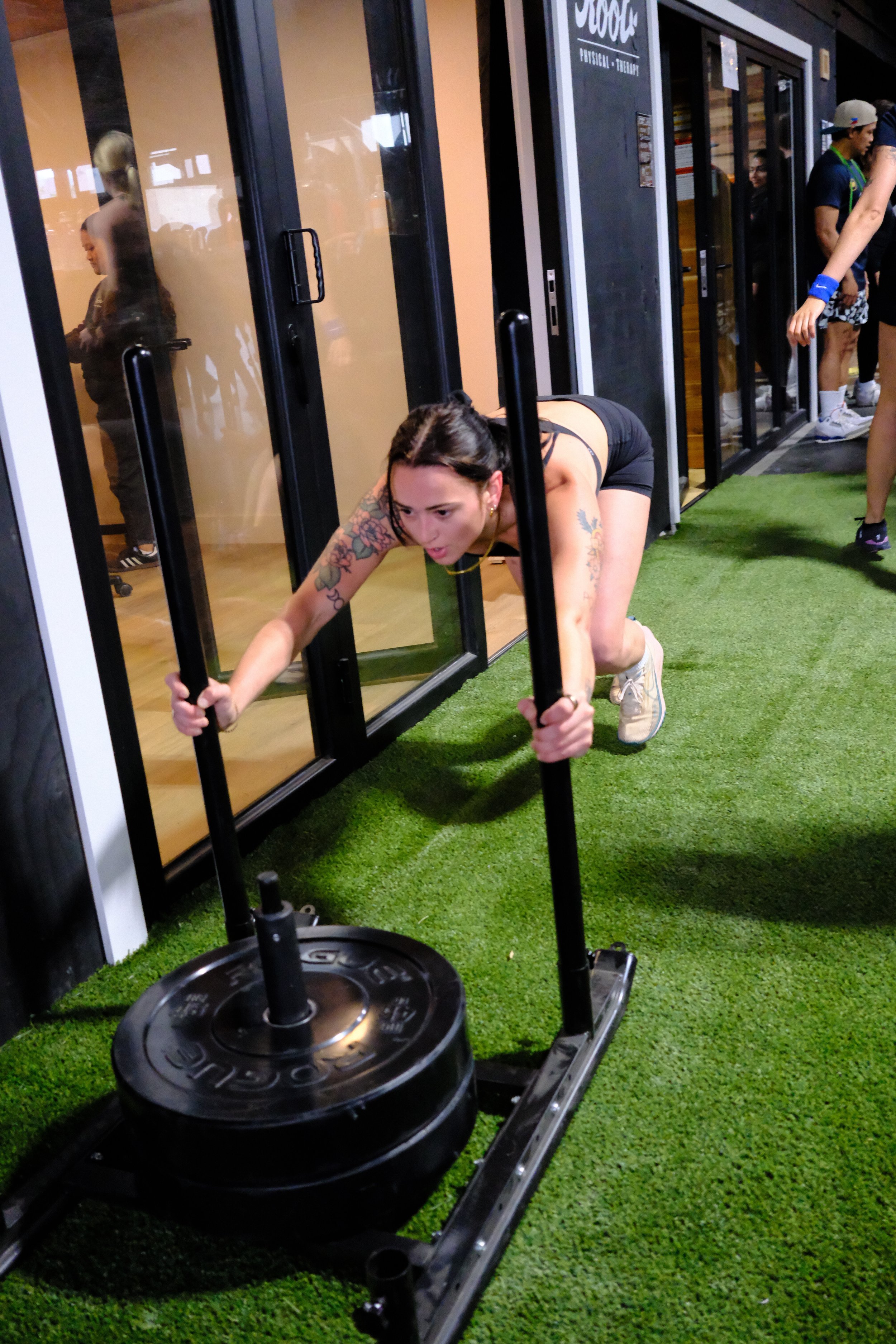
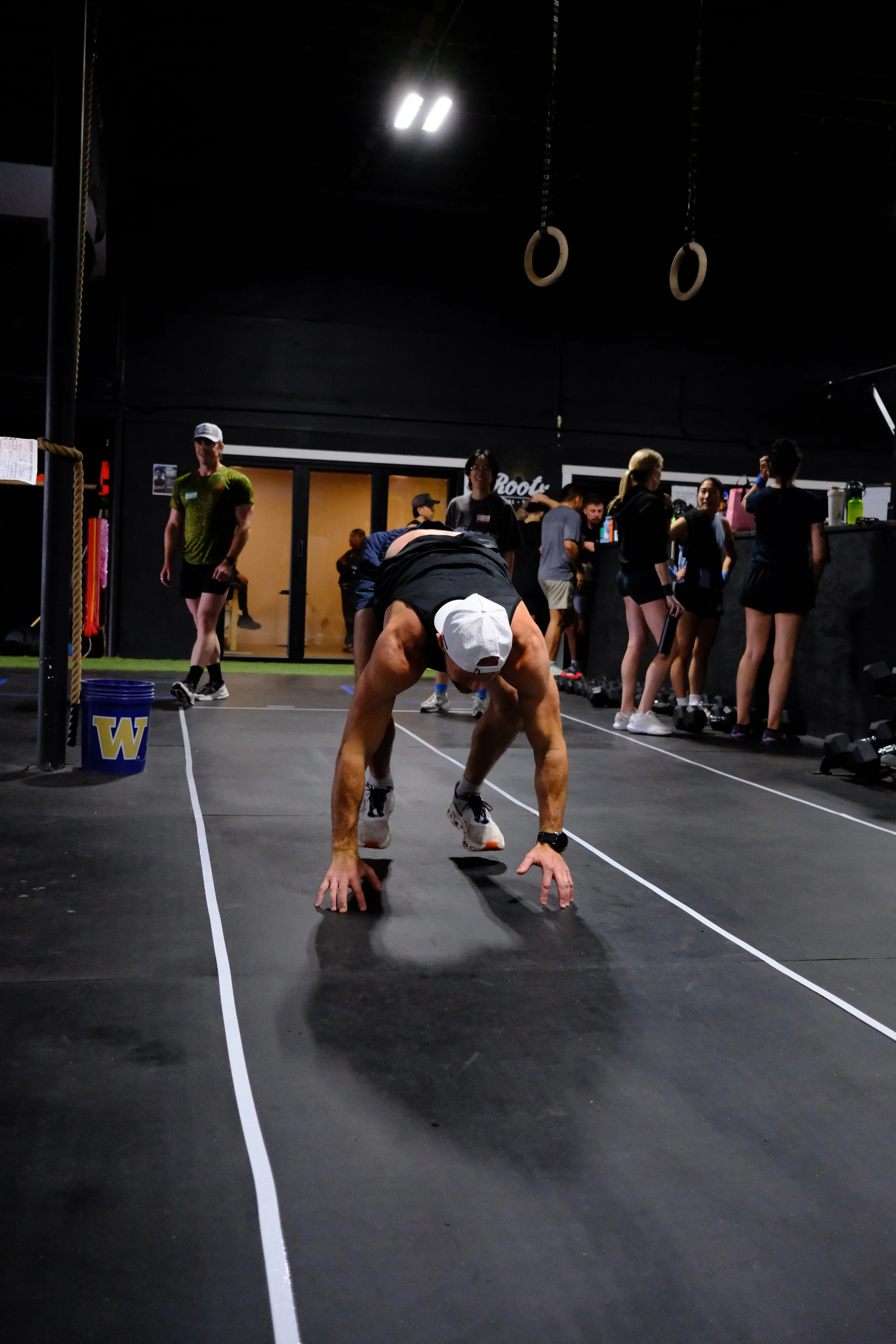
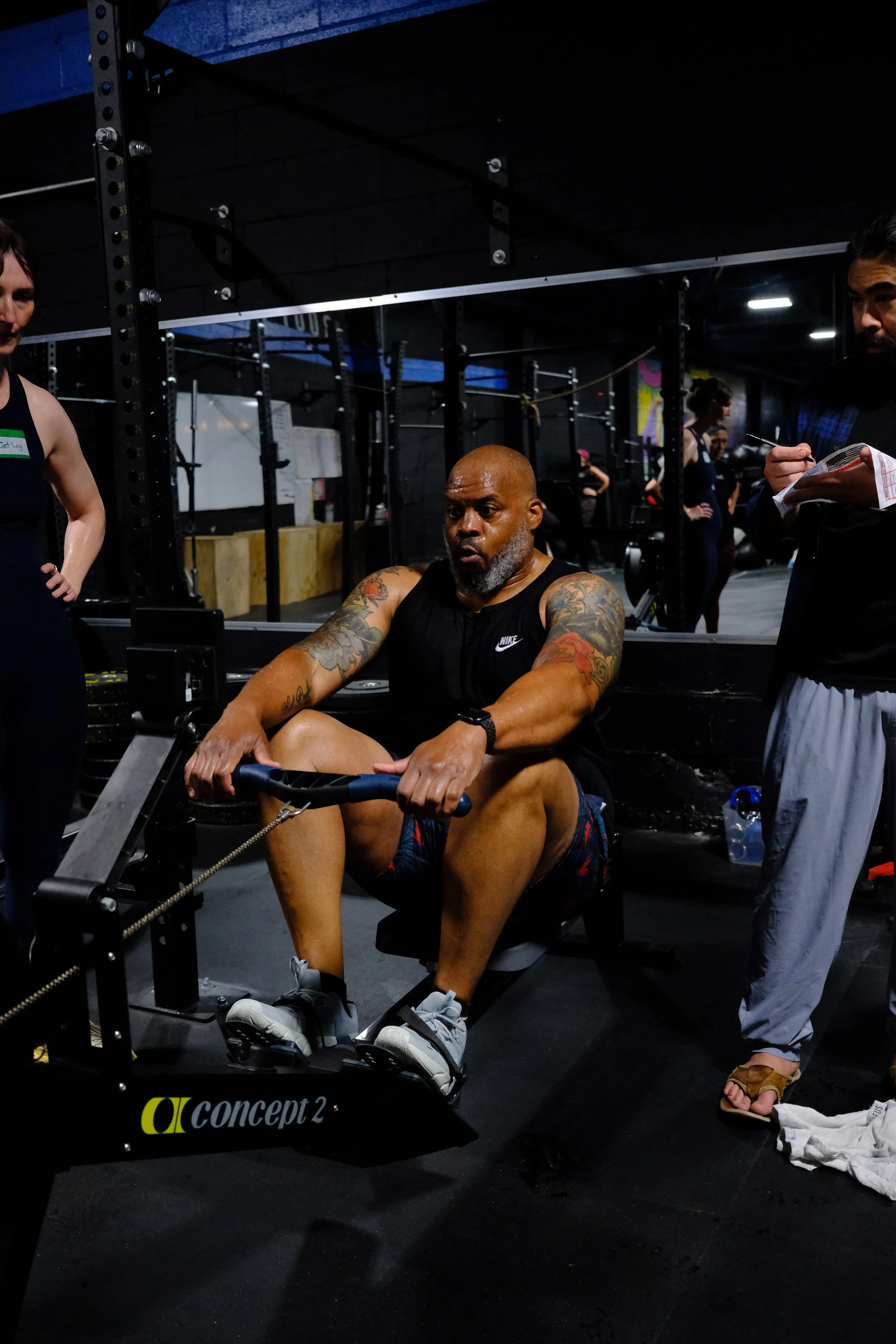
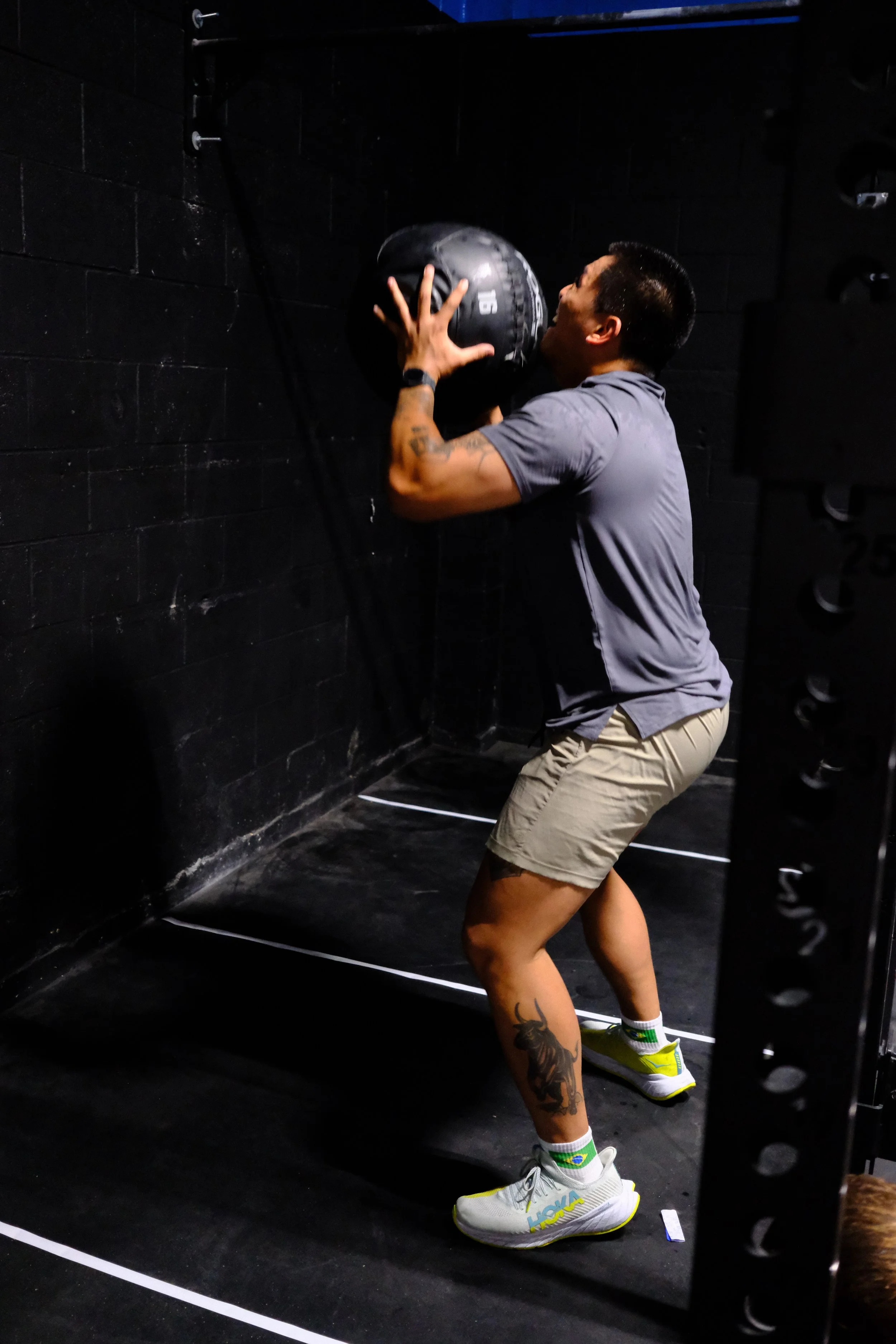
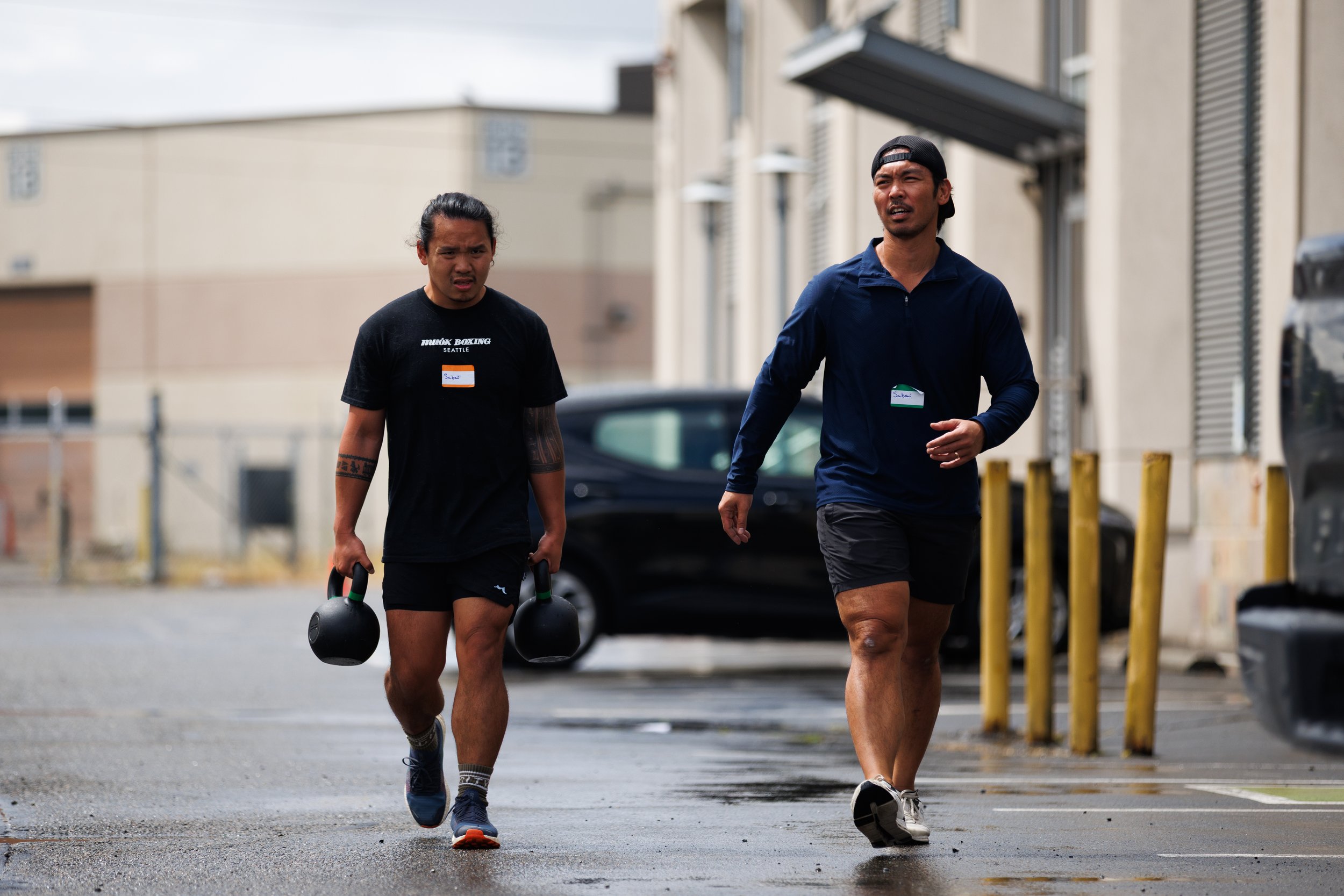
If you take one idea from this guide, take this one: HYROX is not eight stations with some running in between. It's a running race that keeps getting interrupted by things that ruin your running.
Eight of the sixteen segments — more than half your race time for most first-timers — are kilometers run on compromised legs, spiked heart rate, and cooked grip. A fresh 5K time tells you almost nothing about what your kilometer split looks like ninety seconds after a 152-kilogram sled. This is the single biggest gap between how people train and what the race demands: they practice stations fresh and run fresh, and the race never once asks for either.
You don't race eight stations. You race what each one does to the next run.
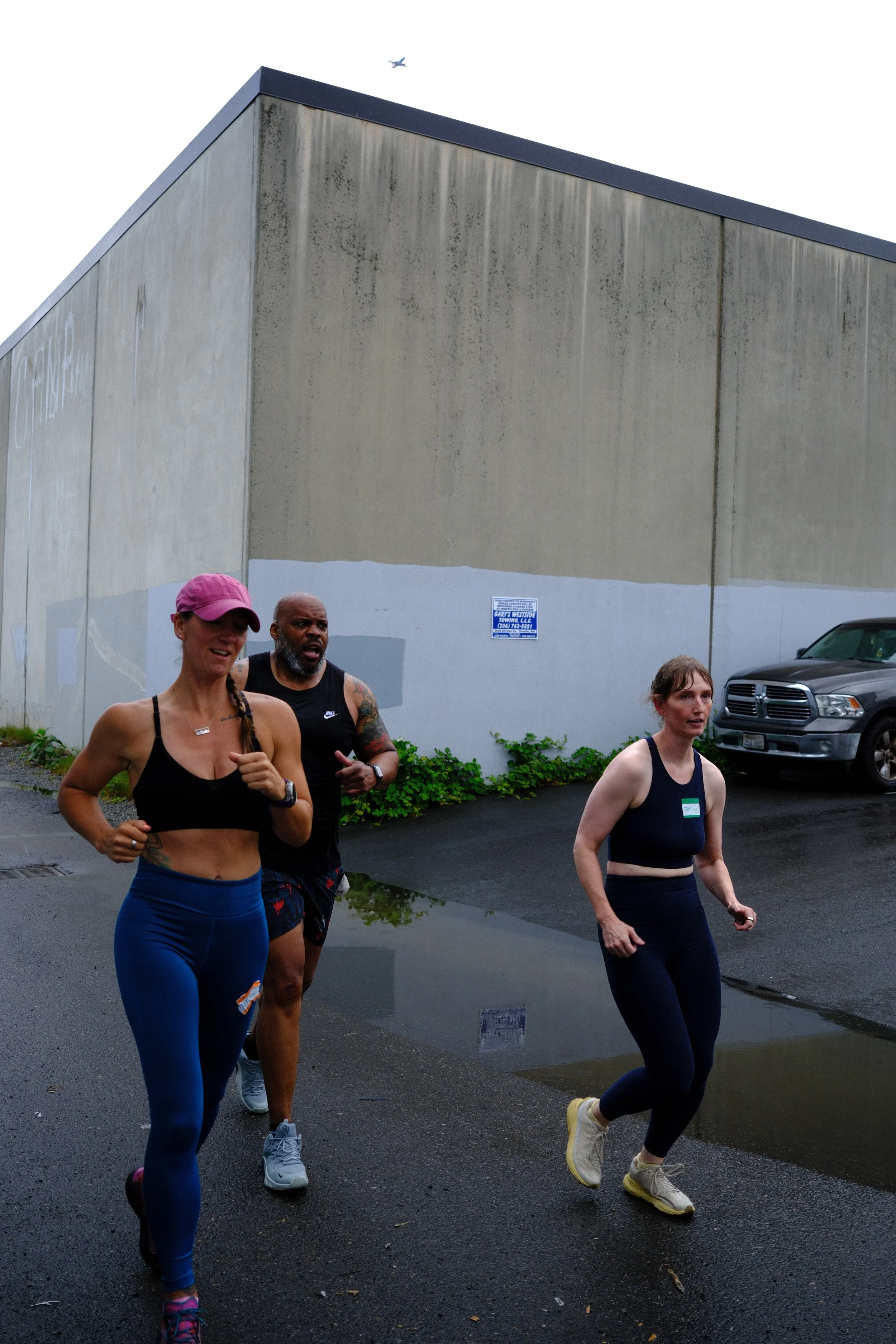
Which is why the core session in HYROX preparation is the compromise brick: a station effort followed immediately by a run, repeated. Sled work into 800s. Wall balls into a kilometer. Teaching your legs to find a rhythm they don't believe exists. It's also why training in a facility matters more for this sport than most — you need sleds, ergs, wall-ball targets, and open floor in the same room, available together, not a run club on Tuesday and a barbell on Thursday.
The first compromise brick is humbling for everyone — the runner and the lifter alike. The runner finds out what their stride feels like with no quads; the lifter finds out the race is mostly cardio wearing a weight vest. That's the point of doing it here first, coached, with the sled loaded to race weight — so race day is a rehearsal, not a revelation. Our HYROX classes are built around exactly this session.
A first-race block needs three things, and most self-built programs contain exactly one of them:
An engine. Eight kilometers of running plus two thousand meters of erg work is an aerobic event, whatever the sleds suggest. Two to three running sessions a week — most of it easy, one of it hard — is the non-negotiable base. If you're coming from lifting, this is your gap, and it's the one that takes longest to build. Start here.
Strength that survives fatigue. The loads in Open aren't extreme by gym standards — that's by design. What's demanding is producing them in minute seventy. Compound lower-body strength (squat, hinge, lunge patterns), grip, and shoulder endurance for a hundred wall balls. If you're coming from running, this is your gap, and no amount of extra mileage closes it.
Race-specific practice. The compromise bricks from Part 03, plus honest time on the stations themselves — sled at race weight, judged-depth wall balls, broad-jump burpees done to standard. Once a week is enough. Zero times a week is how people meet the sled for the first time in a corral.
If a solo race sounds like too much, doubles is the real answer — not a softer one. You share the station work but run every kilometer together, so the fitness demand is genuine while the dark moments are halved. It's also, frankly, the best version of the sport as a social event: nearly half the field at most races is doubles and relay teams. Train with a partner from day one and the block itself gets easier to keep showing up for. Plenty of our members' first races are doubles raced with the person on the next sled over.
Here's what actually happens to a large share of first-time HYROX athletes, and it isn't the sled. It's this: around the middle of the block, when running volume and loading have both been climbing for weeks, something starts to complain. A knee on the downhills. A shoulder in the wall balls. A low back the morning after sled day.
And at that moment, the standard options are both bad. Option one: push through and hope — which is how a manageable irritation becomes the injury that ends the block. Option two: stop training and wait — which surrenders the race, and usually isn't necessary. The frustrating truth is that most mid-block complaints are load-management problems with a clinical answer: modify the aggravating pattern, keep training everything else, rebuild the pattern progressively. But that answer requires someone qualified to give it, quickly, who understands what you're training for.
This is the reason Root Physical Therapy is inside our building, and why the relationship isn't a referral card at the front desk. It's a shared model:
The question isn't whether week six will bite. It's whether your gym has an answer when it does.
Here's the practical wrinkle for Seattle athletes: there's currently no HYROX race in Seattle. The nearest North American stops on the calendar are cities like Anaheim, Salt Lake City, and Denver, with the fall season running from Labor Day weekend through December across markets including Washington DC, Toronto, Boston, Dallas, Tampa, and Nashville.
That changes your planning in two useful ways. First, your race involves travel, so pick it early — races sell out fast, flights and hotels are part of the budget, and a firm date eight to twelve weeks out is what turns training from a vibe into a block. Second, treat the trip as a feature: a destination race with training partners is a better first-race experience than a solo bib in a strange city. Several of our members coordinate around the same event for exactly this reason — you train the block together, you travel together, and there's someone at the finish line who watched you earn it.
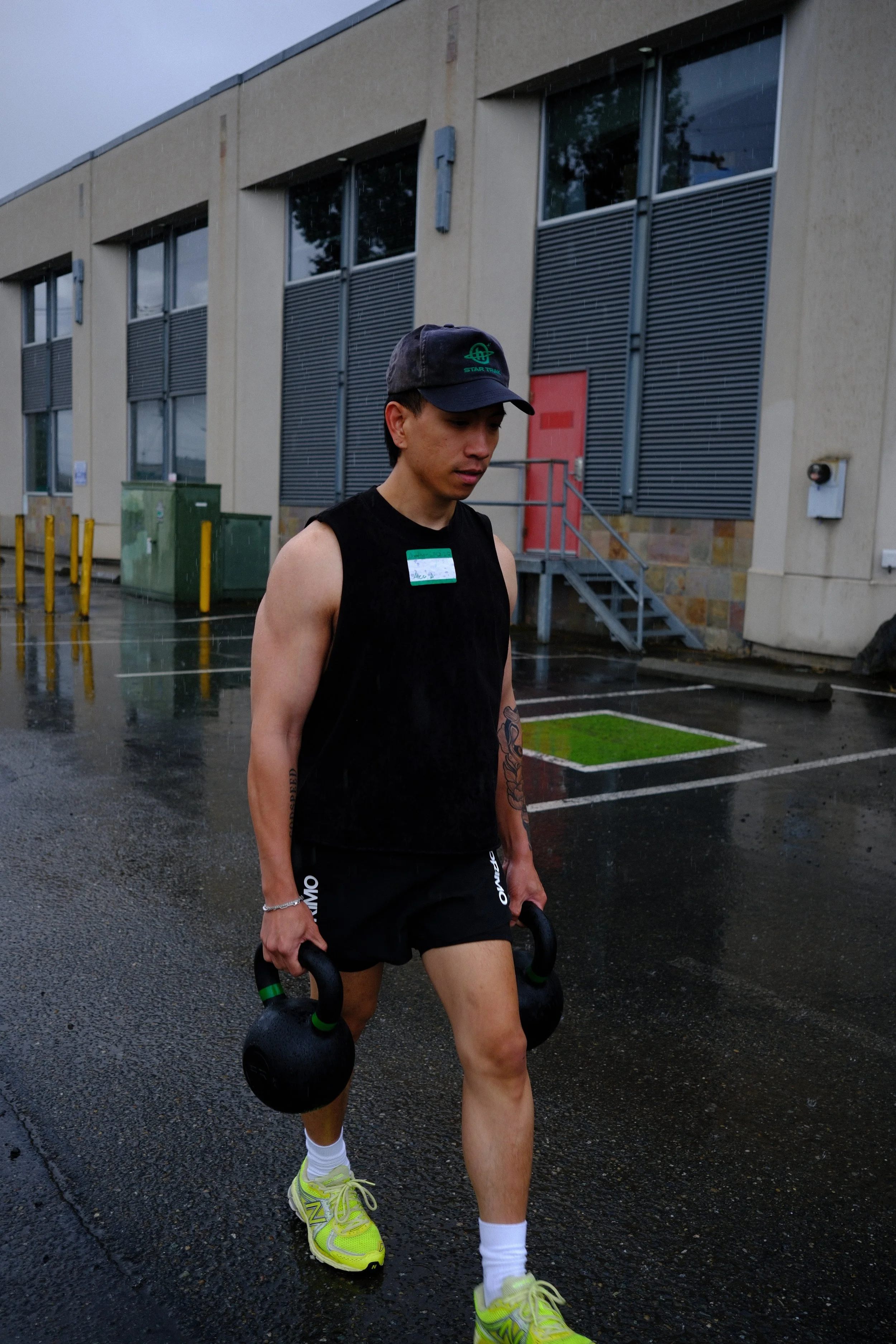
Until Seattle gets its own event, that's the honest local playbook: build the block here, race it wherever the calendar takes you, and bring the time home.
- The format never changes: 8 × 1 km runs alternating with 8 stations, fixed order, standardized worldwide.
- Race Open first. No time cap, standard weights, where ~90% of athletes compete. Pro is a second-season decision.
- Compromised running is the whole game — the race is decided on the kilometers after the sled, not at the stations themselves.
- Train all three ingredients: an aerobic engine, strength that survives fatigue, and weekly race-standard station practice.
- The sled push and wall balls are the two flagged rows — one wrecks the run after it, the other is judged when you're empty.
- Plan for week six. Most mid-block complaints are load-management problems with a clinical answer — if a clinician is actually available.
- No Seattle race yet: pick a travel race early, lock the date, and build the block backward from it.
- Doubles is a real first race — shared station work, every kilometer run together, and the best social version of the sport.
Train the Whole Race.
HYROX-specific classes, strength and MetCon programming, open-floor sleds and ergs 7AM–8PM, sauna to recover — and Doctors of Physical Therapy down the hall for when week six bites. Georgetown, Seattle.
Start the 2-Week Trial — $39.99 →- HYROX (official). Race format, divisions, and event calendar. hyrox.com. 2026.
- HYROX Singles & Doubles Rulebooks, 2026/27 season — station order, loads, movement standards, damper settings, and entry conditions.
- SportsPro. How HYROX is turning fitness into the world's next mass participation sport. June 2026 — participation figures and division split.
- Hybrid Fitness Media. HYROX North America Fall 2026 Schedule. March 2026 — confirmed and new North American race markets.
- HyroxFitness. HYROX Divisions Explained: Open, Pro, Doubles and Relay. Updated July 2026 — division standards and first-timer finish ranges.