

Your First HYROX.
Eight Runs.
Eight Stations.
Ninety Minutes.

HYROX is the fastest-growing race format in fitness — well over a million participants last season, roughly even between men and women, with events selling out cities worldwide. The pitch is simple: a standardized race that any reasonably fit person can finish, and that nobody can fake.
And the format really is simple. What's not simple is the eight to twelve weeks between signing up and standing in the start corral. That's the part this guide is actually about — because the race is the same everywhere, but the training block is where first-timers come apart. Usually around week six. Usually not from a lack of effort.
Here's the whole thing: the format, the stations, the concept that explains the race, how to build your block, and what to do when your body starts sending invoices.
Every HYROX on the planet runs the identical sequence: you run one kilometer, then complete a station, then run again — eight times through, in a fixed order that never changes. Eight kilometers of running, eight stations, done. Complete a station out of order and you're penalized; skip one and you're disqualified. The standardization is the whole point: your time in Seattle is comparable to a time in Stockholm.
Enter Open for your first race. Open has no time cap, the finish rate is very high, and the weights are chosen so that a properly built training block gets an ordinary person through. Pro isn't a qualification you earn — it's a choice — and the honest advice is that it's a choice for your second season, not your first. The sled alone jumps fifty kilograms.
Here's the sequence, with the Open division loads. Notice the last column — it matters more than the other three, and Part 03 explains why.
Two rows are flagged, and they're flagged for the same reason: they're the stations whose cost shows up somewhere else. The sled push doesn't just take two to four minutes — it takes your legs, and the kilometer that follows it is run on whatever's left. Wall balls are the only judged movement standard on the course, and you meet them last, when there is nothing left to judge.
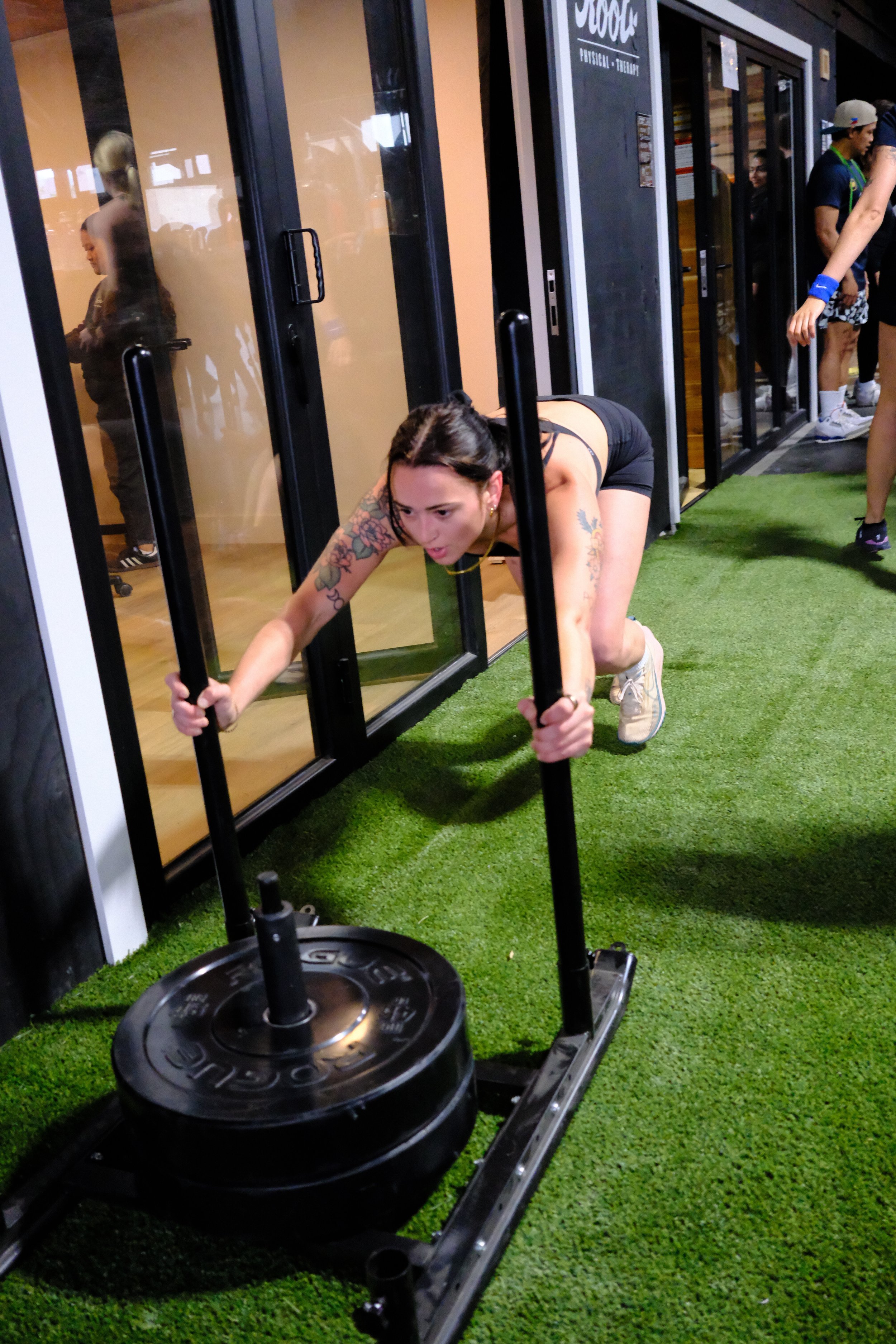
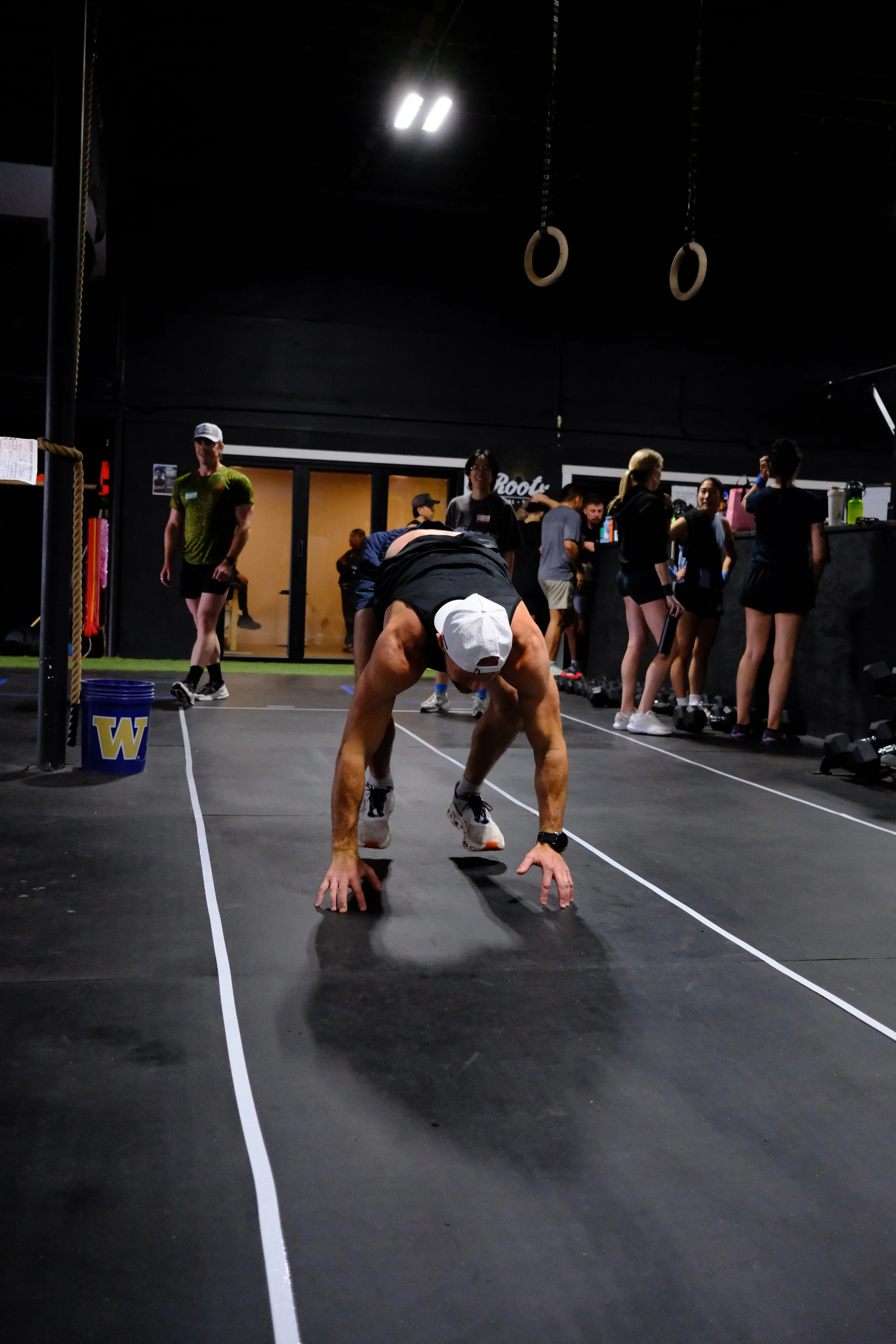

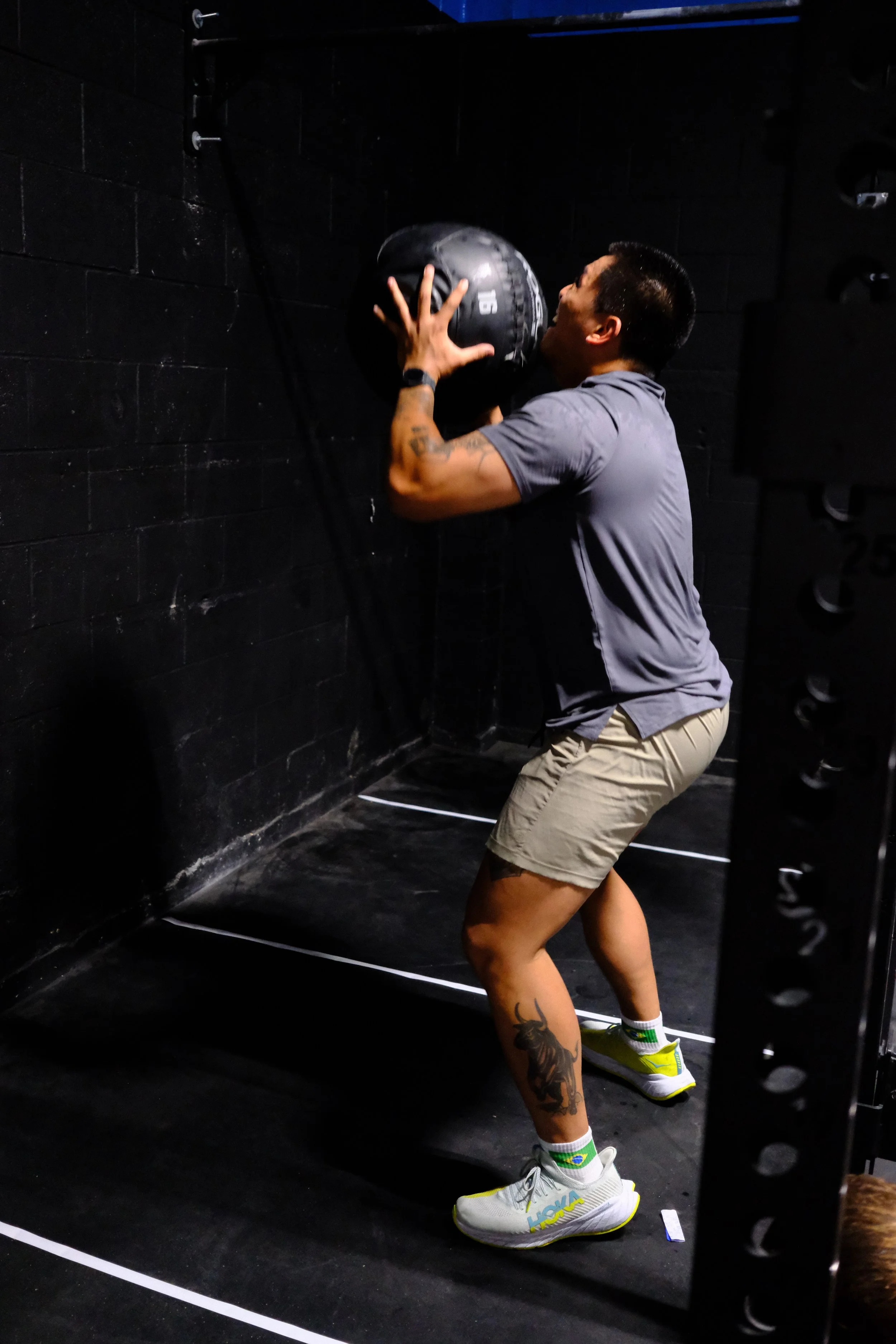
If you take one idea from this guide, take this one: HYROX is not eight stations with some running in between. It's a running race that keeps getting interrupted by things that ruin your running.
Eight of the sixteen segments — more than half your race time for most first-timers — are kilometers run on compromised legs, spiked heart rate, and cooked grip. A fresh 5K time tells you almost nothing about what your kilometer split looks like ninety seconds after a 152-kilogram sled. This is the single biggest gap between how people train and what the race demands: they practice stations fresh and run fresh, and the race never once asks for either.
You don't race eight stations. You race what each one does to the next run.
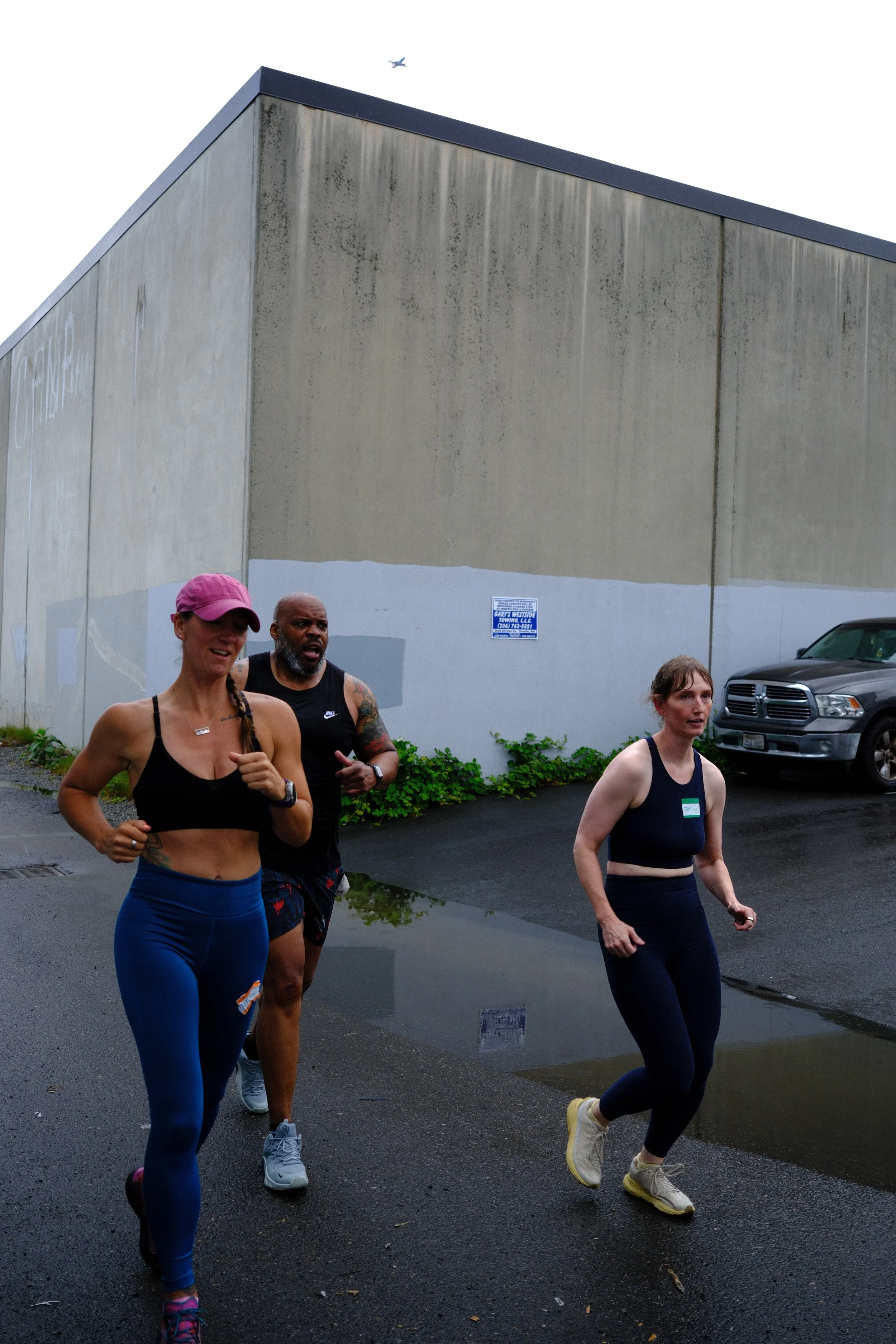
Which is why the core session in HYROX preparation is the compromise brick: a station effort followed immediately by a run, repeated. Sled work into 800s. Wall balls into a kilometer. Teaching your legs to find a rhythm they don't believe exists. It's also why training in a facility matters more for this sport than most — you need sleds, ergs, wall-ball targets, and open floor in the same room, available together, not a run club on Tuesday and a barbell on Thursday.
The first compromise brick is humbling for everyone — the runner and the lifter alike. The runner finds out what their stride feels like with no quads; the lifter finds out the race is mostly cardio wearing a weight vest. That's the point of doing it here first, coached, with the sled loaded to race weight — so race day is a rehearsal, not a revelation. Our HYROX classes are built around exactly this session.
A first-race block needs three things, and most self-built programs contain exactly one of them:
An engine. Eight kilometers of running plus two thousand meters of erg work is an aerobic event, whatever the sleds suggest. Two to three running sessions a week — most of it easy, one of it hard — is the non-negotiable base. If you're coming from lifting, this is your gap, and it's the one that takes longest to build. Start here.
Strength that survives fatigue. The loads in Open aren't extreme by gym standards — that's by design. What's demanding is producing them in minute seventy. Compound lower-body strength (squat, hinge, lunge patterns), grip, and shoulder endurance for a hundred wall balls. If you're coming from running, this is your gap, and no amount of extra mileage closes it.
Race-specific practice. The compromise bricks from Part 03, plus honest time on the stations themselves — sled at race weight, judged-depth wall balls, broad-jump burpees done to standard. Once a week is enough. Zero times a week is how people meet the sled for the first time in a corral.
If a solo race sounds like too much, doubles is the real answer — not a softer one. You share the station work but run every kilometer together, so the fitness demand is genuine while the dark moments are halved. It's also, frankly, the best version of the sport as a social event: nearly half the field at most races is doubles and relay teams. Train with a partner from day one and the block itself gets easier to keep showing up for. Plenty of our members' first races are doubles raced with the person on the next sled over.
Here's what actually happens to a large share of first-time HYROX athletes, and it isn't the sled. It's this: around the middle of the block, when running volume and loading have both been climbing for weeks, something starts to complain. A knee on the downhills. A shoulder in the wall balls. A low back the morning after sled day.
And at that moment, the standard options are both bad. Option one: push through and hope — which is how a manageable irritation becomes the injury that ends the block. Option two: stop training and wait — which surrenders the race, and usually isn't necessary. The frustrating truth is that most mid-block complaints are load-management problems with a clinical answer: modify the aggravating pattern, keep training everything else, rebuild the pattern progressively. But that answer requires someone qualified to give it, quickly, who understands what you're training for.
This is the reason Root Physical Therapy is inside our building, and why the relationship isn't a referral card at the front desk. It's a shared model:
The question isn't whether week six will bite. It's whether your gym has an answer when it does.
Here's the practical wrinkle for Seattle athletes: there's currently no HYROX race in Seattle. The nearest North American stops on the calendar are cities like Anaheim, Salt Lake City, and Denver, with the fall season running from Labor Day weekend through December across markets including Washington DC, Toronto, Boston, Dallas, Tampa, and Nashville.
That changes your planning in two useful ways. First, your race involves travel, so pick it early — races sell out fast, flights and hotels are part of the budget, and a firm date eight to twelve weeks out is what turns training from a vibe into a block. Second, treat the trip as a feature: a destination race with training partners is a better first-race experience than a solo bib in a strange city. Several of our members coordinate around the same event for exactly this reason — you train the block together, you travel together, and there's someone at the finish line who watched you earn it.

Until Seattle gets its own event, that's the honest local playbook: build the block here, race it wherever the calendar takes you, and bring the time home.
- The format never changes: 8 × 1 km runs alternating with 8 stations, fixed order, standardized worldwide.
- Race Open first. No time cap, standard weights, where ~90% of athletes compete. Pro is a second-season decision.
- Compromised running is the whole game — the race is decided on the kilometers after the sled, not at the stations themselves.
- Train all three ingredients: an aerobic engine, strength that survives fatigue, and weekly race-standard station practice.
- The sled push and wall balls are the two flagged rows — one wrecks the run after it, the other is judged when you're empty.
- Plan for week six. Most mid-block complaints are load-management problems with a clinical answer — if a clinician is actually available.
- No Seattle race yet: pick a travel race early, lock the date, and build the block backward from it.
- Doubles is a real first race — shared station work, every kilometer run together, and the best social version of the sport.
Train the Whole Race.
HYROX-specific classes, strength and MetCon programming, open-floor sleds and ergs 7AM–8PM, sauna to recover — and Doctors of Physical Therapy down the hall for when week six bites. Georgetown, Seattle.
Start the 2-Week Trial — $39.99 →- HYROX (official). Race format, divisions, and event calendar. hyrox.com. 2026.
- HYROX Singles & Doubles Rulebooks, 2026/27 season — station order, loads, movement standards, damper settings, and entry conditions.
- SportsPro. How HYROX is turning fitness into the world's next mass participation sport. June 2026 — participation figures and division split.
- Hybrid Fitness Media. HYROX North America Fall 2026 Schedule. March 2026 — confirmed and new North American race markets.
- HyroxFitness. HYROX Divisions Explained: Open, Pro, Doubles and Relay. Updated July 2026 — division standards and first-timer finish ranges.